Amarillo Homeowner Guide
How to Prepare Your AC for an Amarillo Summer: The April–May Checklist
Published September 8, 2026 · Last reviewed · Amarillo, Canyon & Bushland, TX
The short answer
As of September 2026, the best window to prepare a central AC for summer in Amarillo, TX is April through mid-May — after the worst of the spring hail season begins and before average highs climb to 90–93°F in June through August. A homeowner can handle the filter, coil rinse, drain check, and a visual hail inspection for the cost of a filter; a professional pre-season tune-up from a licensed contractor typically costs about the same as a $75–$150 diagnostic visit and catches the weak capacitor or low charge that becomes a July emergency.
Palo Duro Air Repair · (806) 555-0100 · matching Amarillo-area homeowners with independent, TDLR-licensed HVAC contractors.
Most “prepare your AC for summer” articles could have been written anywhere. This one is about Amarillo, where three local facts change the calendar: average highs reach about 90°F in June, 93°F in July, and 91°F in August; the primary hail season runs March through early May with a smaller one in September–October; and the spring winds carry enough dust to clog a filter in a month. Put those together and the pre-season window here isn’t “sometime in spring” — it’s a specific six weeks in April and May when you’re inspecting for hail damage and getting ready for heat at the same time.
The checklist below is split into what you can do yourself and what a licensed technician should do. Repair costs referenced here match the Amarillo AC repair cost guide.
Why April–May, specifically
Three reasons:
- Contractor calendars. In April an Amarillo HVAC shop can usually get to you within days. By late June, after the first week of 95°F afternoons, the same shop is running full after-hours schedules and triaging by urgency. A tune-up that finds a weak capacitor in April is a $150–$400 planned repair; the same capacitor failing on a July Saturday night is an emergency call at $140–$250+ per hour.
- Hail overlap. The primary Panhandle hail season peaks in April and early May. Inspecting the condenser in that window means you catch storm damage — flattened fins, a bent fan blade, a pushed-in grille — before a summer of long run cycles turns a cosmetic problem into a motor or compressor failure. It’s also the right time to have a hail guard installed if you want one.
- Dust. The spring winds are also the dustiest weeks of the year. A coil rinse in mid-May cleans off March and April’s accumulation right before the coil has to work hardest.
The homeowner checklist (an afternoon, roughly the cost of a filter)
Power off at the outdoor disconnect before touching the condenser.
1. Filter
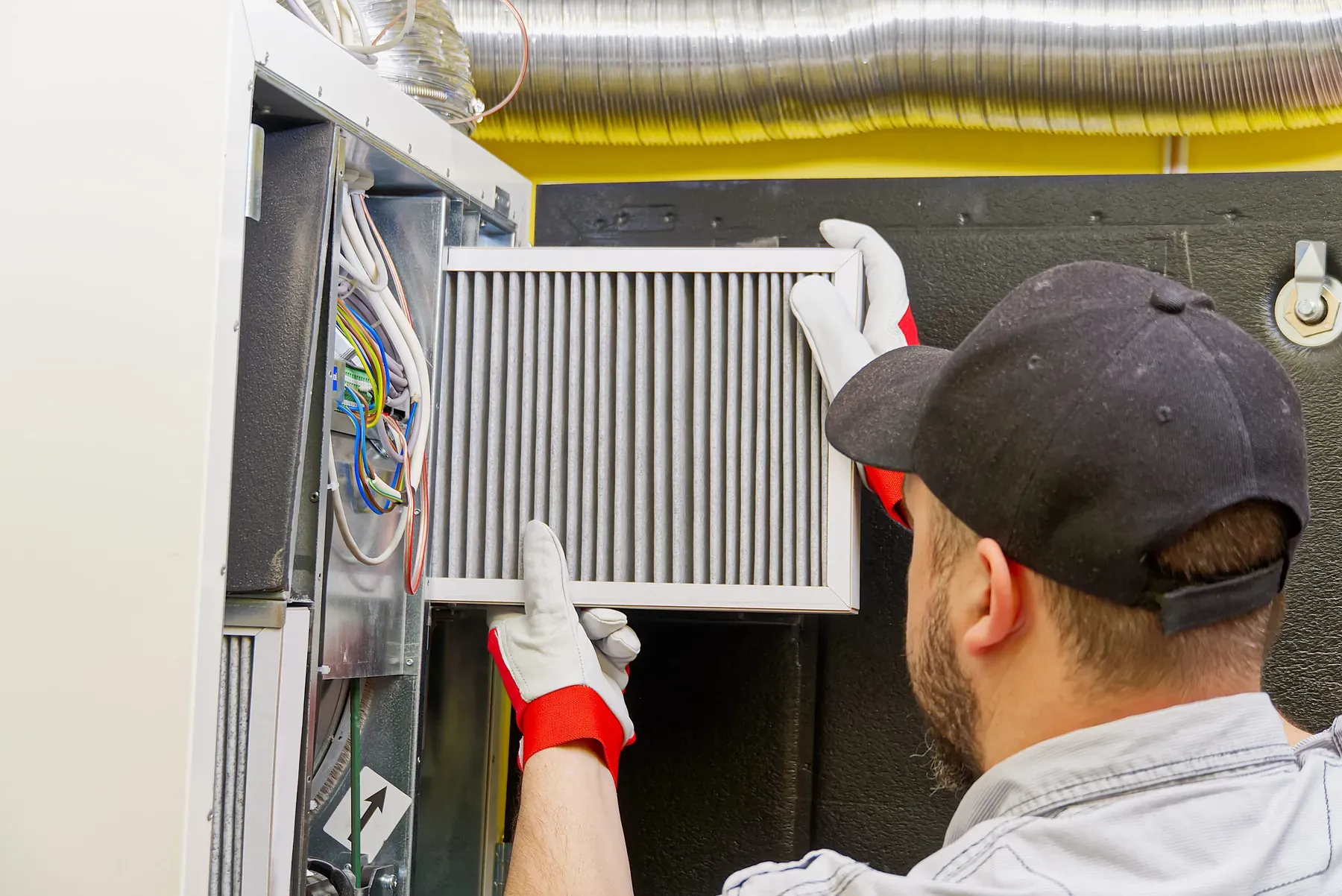
Replace it. Correct size, moderate MERV (8–11 for most homes — very high-MERV filters restrict airflow on systems not designed for them). Then set a monthly reminder from April through September. The fixed “every 90 days” advice is written for places with less dust; here, a filter can be choked in four to six weeks in spring. A clogged filter is the leading cause of a frozen indoor coil and the “running but not cooling” call — see the not-cooling guide.
2. Clear around the outdoor unit
Remove anything that accumulated over winter: leaves, tumbleweed, grass, a cover if you used one. Trim shrubs and grass to leave about two feet of clearance on all sides and five feet above the top grille. A condenser needs to move a lot of air; anything crowding it raises head pressure and run time.
3. Rinse the coil
With power off, rinse the coil fins gently with a garden hose. If the top grille comes off with a few screws and you’re comfortable, rinse from inside out — it pushes dirt out the way it came in. If not, rinse from outside at low pressure. Never use a pressure washer; it flattens the fins as effectively as hail does. Let it dry before restoring power. On a heavily grimed coil, a foaming coil cleaner from a hardware store helps; follow the label.
4. Inspect for hail and winter damage
Walk all four sides. You’re looking for:
- Flattened fins in a splatter pattern — hail. Small areas can be combed at the tune-up; wide areas mean asking for fin-combing specifically.
- Dents in the top grille pushed toward the fan.
- Bent fan blades — sight across them from the side.
- Oily residue on the fins — refrigerant oil weeping from a puncture. That’s a leak, and it moves this from “tune-up” to “repair” ($400–$1,600).
Photograph anything you find. If damage looks significant, the hail-damage guide has a five-tier scale and the insurance order of operations.
5. Condensate drain
Find the drain line outlet outside (a PVC pipe near the foundation, often near the condenser) and the indoor drain pan at the air handler. Flush the line per your unit’s manual or pour water into the pan access and confirm it flows out. If it doesn’t, a wet/dry vac sealed against the outdoor outlet usually pulls the clog. A clogged drain trips the float switch and shuts the system off on the hottest day of the year — it’s the least dramatic and most preventable summer failure there is.
6. Restore power and test
Set the thermostat to cool several degrees below room temperature. Outside, confirm the fan starts and spins smoothly. Listen: a buzz with no fan is a capacitor; a tick that tracks fan speed is a bent blade (the noises guide covers the rest). After 15 minutes, supply air should be noticeably cooler than return air.
7. Thermostat
Fresh batteries. Check the cooling schedule still fits your household. Pick a summer set point you can live with — on a 95°F afternoon every degree lower adds real run time, and an Amarillo system that can’t reach 70°F at 4 p.m. in July isn’t broken, it’s working at its design limit.
8. Book the professional visit
Do this in April, not June. Ask for the specific items in the next section, and ask whether the company offers a maintenance plan with priority summer scheduling — several established Amarillo contractors do, and priority dispatch in a July heat wave is worth more than the plan discount.
What a professional tune-up should include
A real pre-season inspection by a licensed technician produces readings and a written report. Ask for:
- Capacitor and contactor test with the actual microfarad reading versus rated value. A capacitor drifting out of tolerance is replaced now ($150–$400) rather than failing in July.
- Refrigerant pressures and temperature split. A low charge means a leak, not “topping off” — a reputable technician will say so. Leak repair and recharge runs $400–$1,600, more on R-22 systems (see the R-22 guide).
- Electrical connections tightened and motor amperage measured against nameplate. High amps on the condenser fan motor can mean a motor on its way out ($300–$700) or a blade problem.
- Condenser coil cleaned properly, and fins combed if hail flattened them.
- Fan blade and motor inspection — balance, bearing noise, blade condition.
- Condensate drain flushed and float switch tested.
- Blower and indoor coil checked, filter cabinet inspected.
- Thermostat verified for accurate calls.
- A written condition report. On a unit 12 or more years old, ask the technician for an honest read on remaining life — the repair-vs-replace guide explains how to use that.
If the visit lasts fifteen minutes and you get no numbers, it wasn’t a tune-up.
Hail guards: timing and what to insist on
A hail guard — louvered or heavy-mesh panels mounted over the coil faces — meaningfully reduces fin and coil damage from typical Panhandle hail. The right time to install one is this same April window, before the peak weeks, and the right way to buy one is as a quoted line item on the tune-up rather than from a national price list, because unit sizes and products vary. Two non-negotiables: it must not restrict airflow, and it should be rated for your specific unit. Guards make the most sense on newer systems you expect to run another decade and on units with open western or southern exposure, which describes a lot of homes in Bushland and on the south side of Canyon.
The second, smaller window: September
Amarillo’s secondary hail season in September–October arrives just as the system finishes four months of hard running. A lighter fall check — a look at the coil after any storm, a filter change, a drain flush — catches end-of-season damage before it sits all winter. It’s also the season when contractors have time again, which makes it the right moment for the repair-or-replace conversation on an aging unit, rather than the second week of next July.
If the tune-up finds something big
A weak capacitor or a dirty coil is a tune-up finding. A refrigerant leak on an R-22 system, a compressor drawing high amps, or a coil punctured by spring hail on a 13-year-old unit is a decision. Ask the technician to quote the repair and a replacement side by side while they’re there, and read the replacement cost guide — Amarillo replacements run $6,000–$14,500 installed, typically around $9,500 — before you decide.
Book a pre-season inspection
Palo Duro Air Repair connects Amarillo, Canyon, and Bushland homeowners with independent HVAC contractors who report holding an active Texas ACR license. Tell us you want a pre-season inspection and whether you noticed any hail damage, and we’ll match you with a local provider. Verify any contractor at the TDLR license lookup. No obligation to hire.
FAQ
How to Prepare Your AC for an Amarillo Summer: The April–May Checklist: Questions Amarillo Homeowners Ask
When should I get my AC serviced in Amarillo?
April through mid-May is the ideal window in Amarillo — contractors' schedules are still open, the system hasn't yet faced June's 90°F+ highs, and it's early enough in the spring hail season to catch storm damage before it compounds. A second, lighter check in early fall is worth considering because the Panhandle has a smaller secondary hail season in September–October.
How much does an AC tune-up cost in Amarillo?
A pre-season tune-up from a licensed Amarillo contractor typically costs in the same range as a diagnostic visit, $75–$150, with maintenance-plan pricing often lower per visit. Repairs found during the tune-up are quoted separately — a weak capacitor is $150–$400, a low refrigerant charge means a leak repair at $400–$1,600. Several local companies advertise plans that include priority scheduling during the summer rush.
What should a professional AC tune-up include?
A real tune-up includes testing the capacitor and contactor, checking refrigerant pressures and temperature split, tightening electrical connections and measuring motor amperage, cleaning the condenser coil, inspecting the fan blade and motor, flushing the condensate drain, checking the blower and filter, verifying thermostat operation, and giving you a written report of findings. If the visit takes fifteen minutes and produces no readings, it wasn't a tune-up.
Can I clean my AC condenser coil myself?
Yes, for routine dust and debris. Turn off the power at the outdoor disconnect, clear debris by hand, and rinse the fins with a garden hose at low pressure — from the inside out if the top grille comes off easily, otherwise from outside. Never use a pressure washer, which flattens the fins. Heavy grime, oily residue (a sign of a refrigerant leak), or hail-flattened fins call for a technician.
Should I cover my AC unit for hail?
Not while it's running — a cover blocks airflow and will overheat the system. For hail specifically, a permanent louvered or mesh hail guard rated for your unit protects the coil faces without restricting airflow; install it in spring before the peak hail weeks. If a storm is imminent and the system is off, a temporary breathable cover can help, but only if you remember to remove it before the next call for cooling.
Why does my AC filter get dirty so fast in Amarillo?
Amarillo's spring winds carry a lot of fine dust, and a central AC pulls the home's entire air volume through the filter many times a day. A filter that lasted three months in winter can clog in four to six weeks from April through June. Check it monthly in dust season; a clogged filter is the most common cause of a frozen coil and poor cooling.
Keep reading
Related Amarillo AC guides
Ready for a real quote from a local Amarillo HVAC pro?
Tell us what your system is doing and we’ll match you with an independent, TDLR-licensed contractor serving Amarillo, Canyon, and Bushland. No obligation to hire.